Skip to content


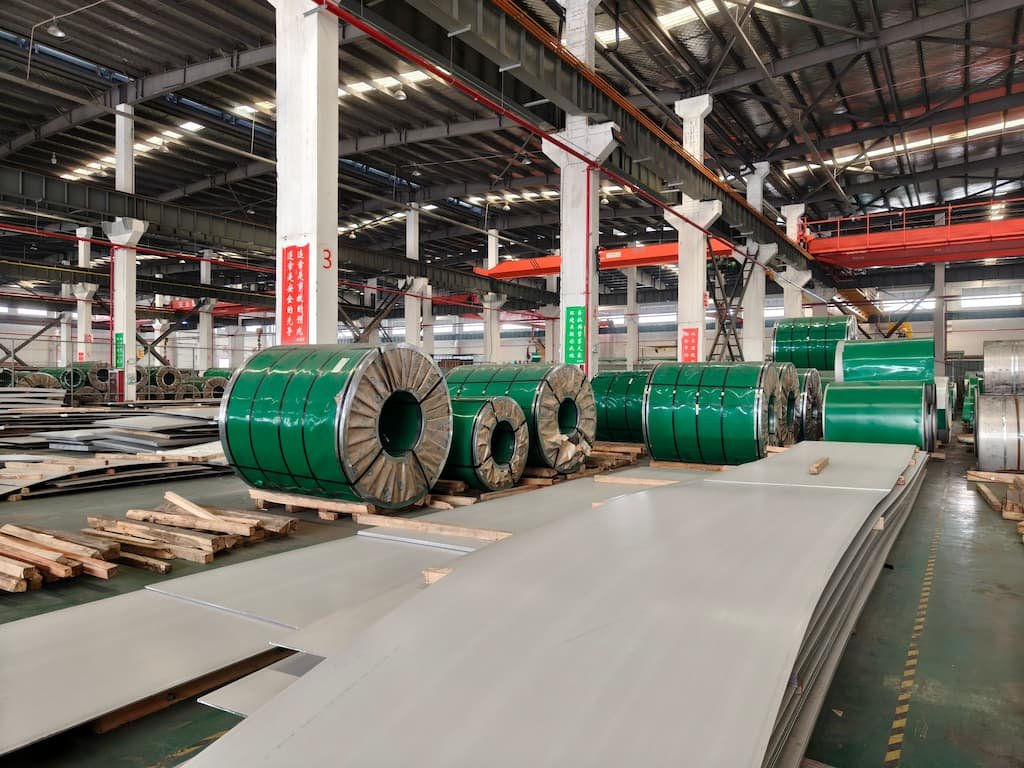
Selecting the correct stainless steel alloy requires a precise balance between environmental corrosion resistance, mechanical yield strength, and raw material cost. Fabricators often struggle to distinguish between grades like 304 and 430, leading to either premature oxidation in chloride-rich settings or unnecessary expenses on over-qualified alloys.
This guide breaks down the chemical compositions and industrial applications of the primary stainless families, focusing on the 200, 300, and 400 series. We examine how the Face-Centered Cubic structure of Austenitic grades drives their dominance—accounting for 70% of global production—and contrast this with the high-strength capabilities of Duplex steel, which delivers yield strengths exceeding 450 MPa for heavy industrial use.
Introduction to Stainless Steel Families
Stainless steel is classified into five primary families—Austenitic, Ferritic, Martensitic, Duplex, and Precipitation Hardening—based on their crystalline microstructure and alloy composition. While all families share a minimum 10.5% Chromium content for corrosion resistance, distinct additions of Nickel, Molybdenum, and Carbon determine their specific mechanical properties and industrial applications.
The Basis of Classification: Microstructure and Alloys
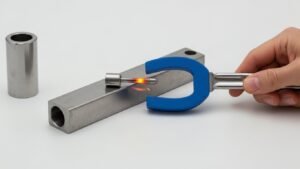
The categorization of stainless steel relies fundamentally on its crystalline structure, which dictates mechanical behavior and corrosion resistance. Metallurgists distinguish these metals by their atomic arrangement, such as the Face-Centered Cubic (FCC) lattice found in Austenitic grades versus the Body-Centered Cubic (BCC) structure characteristic of Ferritic grades. This structural difference explains why Austenitic steels remain non-magnetic and formable, while Ferritic options are magnetic and exhibit different ductility profiles.
Industry standards recognize five major families: Austenitic, Ferritic, Martensitic, Duplex, and Precipitation Hardening (PH). Austenitic grades alone account for approximately 70% of global stainless steel production due to their versatility. Regardless of the specific family, every grade contains a minimum of 10.5% to 12% Chromium. This essential element reacts with oxygen to form a passive, self-healing oxide layer that serves as the primary defense against rust and environmental degradation.
Decoding Grade Standards: AISI and UNS Systems
Engineers and fabricators rely on standardized naming conventions to identify specific alloy compositions accurately. The American Iron and Steel Institute (AISI) utilizes a three-digit system to group these alloys into series. The 300 series designates Austenitic grades, such as the widely used 304 and 316, which contain significant amounts of Chromium and Nickel. Conversely, the 400 series encompasses both Ferritic and Martensitic grades, signaling a different chemical balance that is often nickel-free.
For applications requiring exact chemical constraints, the Unified Numbering System (UNS) offers greater precision through six-character codes. For instance, grade 2205 Duplex stainless steel is referenced as S31803 or S32205, defining its exact nitrogen and molybdenum limits. These designations reflect critical alloying decisions, such as adding Nickel to stabilize the austenitic phase or introducing Molybdenum to enhance resistance against pitting corrosion in chloride-rich environments.
Understanding the Austenitic Series (300s)
The 300 series consists of austenitic chromium-nickel alloys characterized by a Face-Centered Cubic (FCC) crystal structure. These grades, such as 304 and 316, offer excellent ductility, toughness across temperature extremes, and non-magnetic properties in the annealed state. Unlike other series, they harden only through cold working, not heat treatment.
Composition and Metallurgical Characteristics
The 300 series relies on a chemical foundation containing a minimum of approximately 16% chromium and between 8% to 35% nickel. This composition stabilizes the austenitic microstructure, which defines the physical capabilities of the entire family. Unlike ferritic or martensitic grades, these alloys possess a Face-Centered Cubic (FCC) crystal lattice. This structural arrangement ensures high toughness ranging from cryogenic temperatures up to extreme heat, making the material versatile for diverse operating conditions.
Engineers select these alloys for their non-magnetic properties in the annealed condition, although heavy cold working can induce slight magnetism. Hardening occurs exclusively through cold work rather than thermal processes. Heat treatment, such as solution annealing, serves only to restore ductility and corrosion resistance after fabrication steps like welding or forming.
Key Grades and Performance Differences
AISI 304 stands as the baseline “18/8” grade (18% chromium, 8% nickel) for general fabrication, food processing, and architectural use. It functions effectively in standard atmospheric conditions but faces limitations in highly corrosive settings. For environments containing chlorides or marine exposure, AISI 316 provides necessary protection. The addition of 2–3% molybdenum significantly improves resistance to pitting and crevice corrosion, extending the material’s service life in harsh conditions.
High-temperature operations require specialized grades like 309 and 310, which retain strength and oxidation resistance at temperatures exceeding 800°C (1500°F). Fabrication follows established ASTM and EN standards, leveraging the material’s excellent weldability and formability to construct complex pressure vessels and tanks efficiently.
The Ferritic Series Explained (400s)
The Ferritic 400-series consists of straight-chromium stainless steels (typically 10.5–30% Cr) with a body-centered cubic (BCC) grain structure. Unlike the 300-series, these grades are magnetic, contain little to no nickel, and offer superior resistance to chloride stress-corrosion cracking, making them a cost-effective choice for automotive exhausts and indoor appliances.
Defining Characteristics: Microstructure and Magnetism
The defining feature of ferritic stainless steel is its body-centered cubic (BCC) lattice structure. This atomic arrangement keeps the material magnetic in all conditions, a distinct departure from the non-magnetic austenitic 300-series. Because ferritics rely principally on Chromium (11–18%) for corrosion protection and contain little to no nickel, they offer a stable pricing structure less susceptible to raw material market volatility.
Beyond economics, this chemical composition provides specific metallurgical advantages. Ferritic grades exhibit superior resistance to Chloride Stress-Corrosion Cracking (SCC), a common failure mode for standard grades like 304 in chloride-rich environments. Additionally, their thermal profile features lower thermal expansion and higher thermal conductivity than austenitics, making them highly efficient for heat transfer applications such as heat exchangers.
Key Grades and Applications: AISI 409 vs. 430
Industrial selection generally centers on two primary grades: AISI 409 and AISI 430. AISI 409 (UNS S40910) is widely recognized as the “automotive grade.” With approximately 11% Chromium, it prioritizes structural integrity and oxidation resistance over surface aesthetics, making it the standard for exhaust manifolds and catalytic converters.
In contrast, AISI 430 (UNS S43000) serves as the general-purpose ferritic standard. It contains higher Chromium levels (16–18%), which improves corrosion resistance for visible applications like dishwasher linings, washing machine drums, and indoor architectural panels. For applications involving welding or high temperatures, stabilized grades such as 439 or 441 incorporate Titanium or Niobium to prevent sensitization. While these alloys offer excellent utility, engineers must account for their lower ductility and toughness compared to the 300-series, specifically avoiding them in cryogenic environments due to the ductile-to-brittle transition.
High-Performance Stainless Steel Sheets for Every Application

Martensitic Grades: Hardness vs. Corrosion
Martensitic grades prioritize hardness and wear resistance over corrosion protection. By utilizing higher carbon content (0.1–1.2%) and moderate chromium (12–18%), these steels respond to heat treatment (quenching and tempering) to reach tensile strengths up to 1600 MPa and hardness levels exceeding 50 HRC, though they rust more easily than austenitic types.
The Metallurgy of Strength: Carbon vs. Chromium
The fundamental trade-off in martensitic stainless steel lies in its chemical composition. To achieve high mechanical strength, these alloys incorporate significant carbon levels, reaching up to 1.2% in grades like 440C. This high carbon input enables the steel to form a hard, body-centered tetragonal martensitic structure during heat treatment, specifically through quenching and tempering processes.
Unlike the austenitic 300 series, martensitic grades limit chromium content to a range of 12% to 18%. While this provides basic passivation against atmospheric oxidation, the chromium level is intentionally restricted to ensure the material remains hardenable. Higher chromium levels would stabilize the ferritic phase, preventing the necessary phase transformation that generates the steel’s signature strength.
The formation of carbides during tempering creates a secondary effect on performance. While carbides significantly increase wear resistance, they can also create initiation sites for pitting corrosion if the surface is not properly polished or treated. Consequently, the hardened state typically resists corrosion better than the annealed state because alloying elements remain in solution rather than precipitating out as carbides.
Key Grades (410, 420, 440C) and Mechanical Limits
Specific grades illustrate the wide range of mechanical limits within the martensitic family. Grade 440C stands out for offering the highest hardness capabilities, often reaching HRC 55 after heat treatment. This makes it the standard choice for surgical instruments and high-quality knives where edge retention is the primary engineering requirement.
For general-purpose applications involving valves and fasteners, Grade 410 serves as the foundational alloy. It delivers moderate yield strength around 450 MPa, balancing machinability with sufficient hardness for industrial components. While it offers the lowest corrosion resistance among standard stainless grades, it functions well in mild environments.
When applications require enhanced durability in aggressive environments, Grade 431 is utilized. This alloy incorporates nickel to boost corrosion resistance, bringing it closer to the performance of 304 austenitic steel. This modification makes Grade 431 suitable for marine hardware and fasteners that demand high tensile strength without immediate degradation from saltwater exposure.
Duplex Stainless Steel: The Best of Both Worlds
Duplex stainless steel features a balanced microstructure of approximately 50% austenite and 50% ferrite. This dual-phase design delivers twice the yield strength of 300-series stainless steels (typically ≥450 MPa) and exceptional resistance to chloride stress corrosion cracking, making it ideal for aggressive industrial environments.
The 50/50 Austenite-Ferrite Microstructure
The defining characteristic of Duplex stainless steel is its mixed microstructure, which combines roughly 50% austenite and 50% ferrite phases (with a minimum of 30% ferrite required by volume). This hybrid design creates a material that outperforms single-phase grades by merging the best properties of both. Specifically, it achieves yield strengths between 450 MPa and 550 MPa, effectively doubling the strength of standard austenitic grades like 316L, which typically offer around 200 MPa.
Beyond structural strength, the ferritic component provides superior resistance to chloride stress corrosion cracking (SCC) and pitting, addressing common failure points in standard 304 or 316 grades. The chemical composition is engineered to maintain this balance, typically utilizing 18–28% chromium to stabilize the ferrite and 4.5–8% nickel for the austenite. Nitrogen (0.15–0.40%) is often added as a critical alloying element to enhance strength and further stabilize the microstructure against intermetallic precipitation.
Common Grades (2205 & 2507) and Usage Limits
Market selection largely revolves around two primary categories. Standard Duplex 2205 (UNS S32205) serves as the industrial workhorse, formulated with 22% chromium and 3% molybdenum. It provides a yield strength ≥450 MPa, making it suitable for chemical tankers and general structural applications. For more severe environments, Super Duplex 2507 increases the alloy content to 25% chromium and roughly 3% molybdenum, achieving a Pitting Resistance Equivalent Number (PREN) of 40–45 for harsh marine and subsea use.
Operational success with Duplex steel requires strict adherence to temperature limits, generally ranging from -50°C to 300°C. Usage above 300°C is not recommended due to the risk of embrittlement, where the ferrite phase decomposes and toughness drops significantly. Additionally, welding processes demand careful heat input control. Exposure to temperatures between 700°C and 955°C can induce sigma phase precipitation, a brittle constituent that severely degrades corrosion resistance and impact toughness.
Chemical Composition Comparison Chart
Stainless steel grades are defined by specific ratios of alloying elements. Chromium (min 10.5%) provides basic corrosion resistance, Nickel (8-14% in 300-series) stabilizes the structure for formability, and Molybdenum (2-3% in 316) adds resistance to pitting. This chart compares the exact ASTM/AISI composition limits for common Austenitic, Ferritic, Martensitic, and Duplex grades.
| Grade (AISI/UNS) | Base Composition (Cr / Ni) | Key Modifiers (Mo / C / Other) |
|---|---|---|
| 304 (S30400) | Cr: 18.0-20.0% Ni: 8.0-10.5% | C: 0.08% max Mn: 2.0% max |
| 304L (S30403) | Cr: 18.0-20.0% Ni: 8.0-12.0% | C: 0.03% max (Better Weldability) |
| 316 (S31600) | Cr: 16.0-18.0% Ni: 10.0-14.0% | Mo: 2.0-3.0% (Pitting Resistance) C: 0.08% max |
| 316L (S31603) | Cr: 16.0-18.0% Ni: 10.0-14.0% | Mo: 2.0-3.0% C: 0.03% max |
| 430 (Ferritic) | Cr: 16.0-18.0% Ni: <0.75% (Minimal) | C: 0.12% max Magnetic Structure |
| 410 (Martensitic) | Cr: 11.5-13.5% Ni: Minimal | C: 0.15-0.30% (Hardness) |
| 2205 (Duplex) | Cr: 22.0-23.0% Ni: 4.5-6.5% | Mo: 3.0% Mixed Microstructure |
Key Alloying Elements and Their Impact
Chromium acts as the primary agent for corrosion resistance, requiring a minimum of 10.5% to form the passive oxide layer that protects the steel. In austenitic grades, levels typically range from 16% to 26%. Nickel serves as an austenite stabilizer, essential for ductility and formability; grade 304 contains 8% to 10.5% nickel, whereas ferritic 430 contains minimal amounts. Molybdenum, found in grade 316 (2.0-3.0%) and Duplex 2205 (3%), drastically improves resistance to pitting in chloride-rich environments. Carbon levels differ significantly by application; ‘L’ grades limit carbon to 0.03% for welding, while martensitic 410 increases it to 0.15-0.30% for hardness.
Standard Composition Ranges by Grade (ASTM/AISI)
The 300 series dominates general applications, with 304 (18-20% Cr, 8-10.5% Ni) serving as the standard and 316 adding molybdenum for marine environments. Ferritic and Martensitic grades like 430 and 410 offer distinct properties; 430 maintains corrosion resistance without nickel for cost efficiency, while 410 sacrifices some corrosion resistance for strength. Duplex 2205 bridges the gap, utilizing 22-23% chromium and 4.5-6.5% nickel to achieve a mixed microstructure. Adherence to tight ASTM tolerances, such as keeping sulfur below 0.03%, ensures these materials perform predictably in industrial fabrication.
Choosing Grades for High-Temp Environments
Selecting the right high-temperature grade depends on balancing oxidation resistance (provided by Chromium) and creep strength (enhanced by Nickel). For continuous service up to 925°C, standard 304 is often sufficient. Extreme heat up to 1150°C demands high-alloy grades like 310 or 309. In sulfur-rich environments, ferritic grades like 446 are preferred to prevent nickel sulfide attack.
Critical Selection Factors: Oxidation, Creep, and Atmosphere
Metallurgical mechanisms directly dictate performance in high-heat applications. Oxidation and scaling resistance depend heavily on Chromium content. Grades containing 18-25% Chromium form a tight, protective oxide layer that prevents material degradation. For example, Grade 310 utilizes 25% Chromium to maintain stability in dry air, preventing the surface from flaking off at elevated temperatures.
Creep strength becomes the primary concern when materials operate under load at temperatures above 600°C. Metals can slowly deform over time under these conditions. Adding Nickel (12-20% in grades like 309 and 310) significantly boosts creep rupture strength compared to standard ferritic grades. This makes austenitic grades superior for load-bearing structural components in furnaces.
Environmental chemistry also drives material selection. Atmospheric conditions containing sulfur or reducing gases aggressively attack Nickel, leading to rapid failure in austenitic steels. In these specific scenarios, Ferritic grades such as 446 or 430 are safer choices, despite their lower creep strength, because they resist nickel sulfide attack up to temperatures of 815-870°C.
Maximum Service Temperatures for Standard Grades
Engineers must map application temperatures to the specific limits of each grade. For extreme heat applications, austenitic Grade 310 leads the standard lineup with a continuous service limit of 1150°C. Grade 309 follows closely, handling up to 1095°C, which makes both grades ideal for furnace parts, heat exchangers, and kiln linings.
In standard service environments, common Grade 304 performs reliably up to 925°C in continuous operation. Grade 316, while excellent for corrosion resistance, has a lower thermal limit of approximately 870°C in continuous service due to faster scaling rates compared to 304.
Specialized Ferritic grades offer alternatives where high load-bearing strength is not required. While standard 430 is limited to 815°C, high-chromium 446 withstands temperatures up to 1100°C. This makes 446 a viable option for high-temperature applications where sulfur presence rules out the use of high-nickel alloys.
Common Applications by Industry
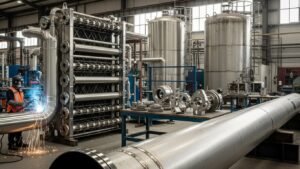
Stainless steel applications range from hygienic environments in food processing (Grade 304) to high-stress offshore platforms using Duplex 2205. While ferritic grades like 409 dominate automotive exhaust systems due to thermal properties, austenitic 316 and Super Duplex 2507 are essential for corrosion resistance in marine and chemical infrastructure.
| Industry Sector | Common Grades | Key Performance Requirement |
|---|---|---|
| Food & Beverage | 304, 304L | FDA compliance, ease of sanitation |
| Marine & Chemical | 316, 2507 | Chloride pitting resistance |
| Automotive | 409, 430 | High-temperature oxidation resistance |
| Oil & Gas | Duplex 2205 | Yield strength up to 1000 MPa |
| Medical | 420 | High hardness for cutting edges |
Sanitary, Automotive, and Architectural Uses
Industries that interface directly with consumers prioritize hygiene, aesthetics, and cost-efficiency. In the **Food and Beverage** sector, 304 and 304L grades (ASTM A351 CF8/CF3) act as the global standard for brewing equipment, dairy silos, and kitchen surfaces. These austenitic grades meet strict FDA compliance standards because their surface finish resists bacterial growth and withstands frequent chemical cleaning without corroding.
The **Automotive** industry relies heavily on ferritic grades for components exposed to high heat. Manufacturers use Grade 409 extensively in exhaust systems and catalytic converters because it resists high-temperature oxidation better than carbon steel while remaining economical. For visible components like decorative trim, Grade 430 offers a polished finish and lower thermal expansion, ensuring structural stability during temperature fluctuations. Additionally, **Medical** applications demand martensitic Grade 420 for surgical instruments, utilizing its high hardness and wear resistance to maintain sharp cutting edges.
Marine, Chemical, and Energy Sector Applications
Heavy industries operate in aggressive environments that require alloys with superior corrosion resistance and tensile strength. **Marine** environments depend on 316 and 316L grades (ASTM A351 CF8M/CF3M) for boat fittings and submerged infrastructure. The addition of molybdenum in these grades specifically targets resistance to chloride-induced pitting caused by saltwater, a common failure point for standard 304 stainless.
In the **Oil, Gas, and Chemical** sectors, extreme pressure and corrosive fluids necessitate advanced alloys. Engineers specify Duplex 2205 and Super Duplex 2507 for pipelines, pressure vessels, and desalination plants. These grades offer yield strengths up to 1000 MPa—nearly double that of austenitic steels—while withstanding stress corrosion cracking in harsh chemical tanks. For **Aerospace** components like valves and high-strength fittings, 17-4 PH provides a critical balance of precipitation-hardened strength and corrosion resistance required for flight-critical hardware.
Final Thoughts
Selecting the correct stainless steel grade demands a precise evaluation of environmental stresses and mechanical loads rather than a simple reliance on general corrosion resistance. While the austenitic 300 series serves as a versatile baseline for many industries, ignoring the specialized capabilities of ferritic or duplex alloys often results in inflated costs or structural inefficiencies. Engineers and fabricators must weigh factors such as chloride exposure, operating temperatures, and weldability to determine if a standard grade like 304 fits the application or if the project requires the enhanced durability of 316 or 2205.
Material specification directly dictates the lifecycle and safety of the final component. Matching the alloy’s atomic structure to its service environment prevents common failure modes like stress corrosion cracking and pitting. As manufacturing standards evolve, a deep understanding of these metallurgical families ensures that built infrastructure—from kitchen sanitary ware to offshore pipelines—maintains integrity throughout its intended service life.
Frequently Asked Questions
What is the difference between 304 and 430 stainless steel?
304 is an austenitic grade containing 8.0-10.5% nickel, which provides superior ductility and corrosion resistance with a minimum yield strength of 205 MPa. 430 is a ferritic grade with no nickel; while it offers good oxidation resistance, it is less corrosion-resistant and magnetic, with a higher minimum yield strength of 345 MPa.
Is 201 stainless steel magnetic?
In its fully annealed condition, 201 stainless steel is essentially non-magnetic (permeability < 1.02). But it becomes noticeably magnetic after cold working due to the formation of martensite in its microstructure.
Which grade is best for marine environments?
316 stainless steel is the standard choice for marine applications. Its 2-3% molybdenum content specifically resists chloride-induced pitting better than 304. For extreme splash zones or submerged use, super duplex grades like UNS S32750 are often specified.
What does “18/8” stainless steel mean?
“18/8” is a common designation for 304 stainless steel, indicating a nominal chemical composition of 18% chromium and 8% nickel. This specific ratio creates the stable austenitic structure found in the most widely used stainless grades.
Can you weld 400 series stainless steel?
Yes, but it requires strict procedure controls compared to the 300 series. Martensitic grades (like 410) need preheating to roughly 177–204°C (350–400°F) and post-weld heat treatment to avoid cracking. Ferritic grades (like 430) require low heat input and often use austenitic fillers to maintain toughness.
What is the hardest stainless steel grade?
440C is the hardest standard stainless steel. It is a martensitic grade that can achieve a hardness of HRC 58–62 (approx. 700 Brinell) after heat treatment, surpassing grades like 420.