Skip to content


Assessing Supplier Production Capacity
Buyers should evaluate capacity by auditing Environmental Product Declarations (EPDs) and verifying precision tolerances. Leading mills produce over 1.2 million tons annually with line speeds of 80–120 m/min, while precision specialists maintain gauge control within ±0.0003 inches through automated cluster mill systems.
Auditing Mill Throughput and Environmental Standards
Verifying a mill’s actual output requires reviewing mill-gate data through Environmental Product Declarations (EPDs). These documents must comply with ISO 14025 and ISO 21930:2017 to provide an accurate baseline for annual tonnage. High-volume cold rolling operations typically maintain line speeds between 80 and 120 m/min, which supports a total output exceeding 1.2 million tons per year for strip and coil products.
Efficiency benchmarks provide insight into the technical maturity of the facility. Modern facilities using Electric Arc Furnace (EAF) routes often utilize up to 97% recycled scrap. Evaluating these metrics allows buyers to confirm that the supplier possesses the infrastructure necessary to meet large-scale 2026 delivery schedules without compromising on material intensity or environmental compliance.
Verifying Precision Limits and Quality Protocols
Technical compliance relies on the mill’s ability to maintain tight tolerances across the entire coil length. Precision specialists use cluster mill systems and in-line measurement tools to hold gauge tolerances within ±0.0003 inches (±7.6 μm) and width tolerances of ±0.002 inches (±0.05 mm). These metrics distinguish high-performance production lines from standard commodity mills.
Buyers must validate mechanical properties against industry standards like ASTM A240/A240M and ANSI/AISC 370-21. Quality control protocols should include automated sampling and non-destructive testing (NDT), such as ultrasonic and radiographic methods, for every heat. Facilities that integrate these tests directly into the production line ensure higher reliability for yield strength, tensile strength, and elongation requirements across high-volume orders.
Coil Specifications: ID, OD, and Weight Limits
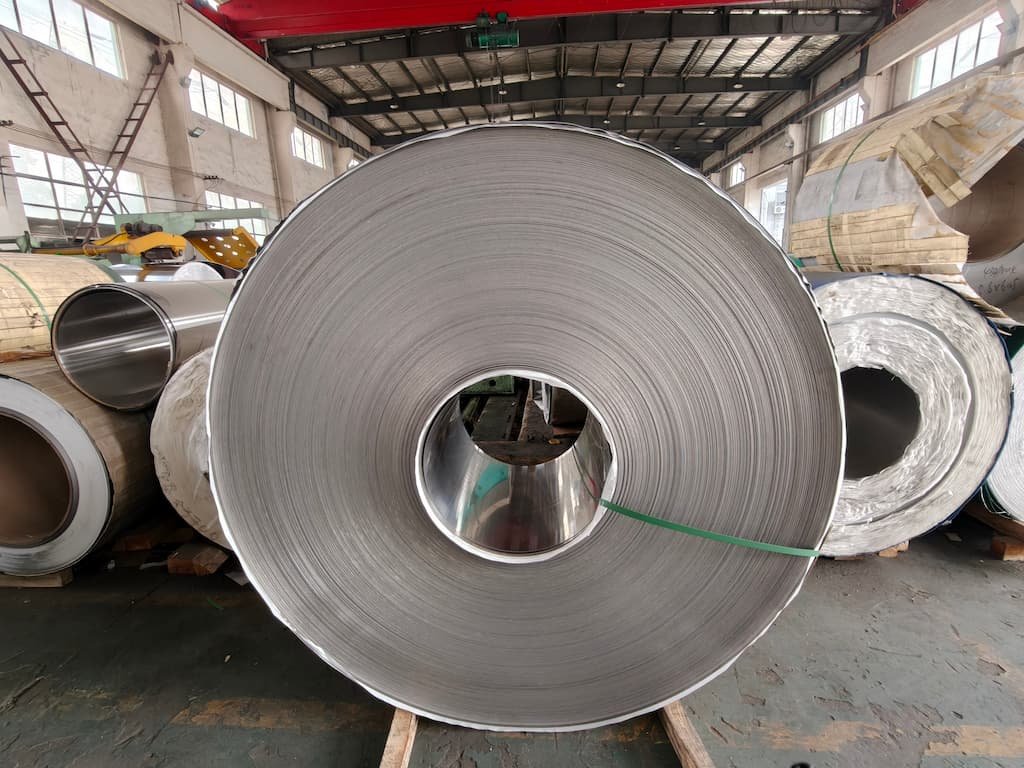
Standard stainless steel coils in 2026 typically feature inner diameters of 508 mm or 610 mm to match industrial mandrels. Weights generally range from 3 to 25 metric tons, with outer diameters reaching up to 2134 mm. Buyers must align these specs with their decoiler capacity and transport limits.
| Dimensional Parameter | Standard Specification | Extended/Industrial Max |
|---|---|---|
| Inner Diameter (ID) | 508 mm / 610 mm | 406 mm to 914 mm |
| Outer Diameter (OD) | 900 mm to 2000 mm | Up to 2134 mm |
| Coil Weight | 3 to 25 Metric Tons | Up to 40 Metric Tons |
Standard Inner Diameter and Mandrel Compatibility
Mills supply 508 mm (20 in) and 610 mm (24 in) as the dominant global standards for stainless coil inner diameters. These sizes align with the expansion capabilities of standard decoiler mandrels found in most service centers and high-volume manufacturing plants. Standardizing on these dimensions across grades like 304 and 316L allows for seamless processing on automated lines without the need for frequent tooling changes.
Specific equipment configurations may accommodate a broader range from 406 mm to 914 mm (16 to 36 in). These variations typically apply to specialized narrow strips or exceptionally heavy gauge materials. Securely matching the coil ID to the decoiler mandrel prevents material slippage and maintains stability during high-speed unrolling operations, protecting the surface finish of the stainless steel.
Outer Diameter Ranges and Weight Limits
Commercial stainless steel supply usually falls within a weight envelope of 3 to 25 metric tons per coil. High-volume producers frequently offer heavy-duty coils that reach 40 metric tons for 300-series grades. These larger units improve production efficiency by reducing the frequency of coil changeovers on continuous feed lines, though they require significant crane and floor loading capacity.
Typical outer diameters range from 900 mm to 2000 mm (35 to 79 in). Advanced processors can manage specialized outer diameters up to 2134 mm (84 in). Effective logistics planning involves back-calculating total coil weight based on the material width and thickness to stay within the safe working limits of trucks and overhead cranes. The maximum weight capacity of the processing line often determines the total continuous length of the material available for a single production run.
Edge Conditions: Mill Edge vs. Slit Edge
Choosing between mill and slit edges impacts fabrication safety and material costs. Mill edges are rough, untreated, and cost-effective for further processing. Slit edges provide precise widths and cleaner lines but require careful handling or deburring to prevent edge cracking and safety hazards during 2026 production cycles.
Defining Mill Edge and Slit Edge Characteristics
Mill edges, often designated as #2 edges, represent the natural state of stainless steel as it leaves the rolling mill. These edges retain the original contours from the hot or cold rolling process, resulting in a rougher appearance with inherent irregularities and burrs. Fabricators typically choose mill edges for projects where the final edge quality does not impact the component’s function or where the material will undergo significant secondary trimming that removes the original perimeter.
Slit edges, or #3 edges, are created by passing a master coil through mechanical slitting lines to produce narrower strips with uniform widths. This process yields a significantly straighter and cleaner line than a mill edge. While visually more precise, a slit edge possesses a small mechanical burr created by the shearing action of the blades. Operators must follow specific handling protocols to manage these sharp edges and ensure safety during the assembly of precision strips and banding products.
Processing Options and Selection Criteria
Secondary processing allows for the creation of specialized edge profiles like the #1 Round Edge or #5 Deburred Edge. These conditions are achieved through skiving or rolling techniques that physically remove the slitting burr. Conditioned edges are essential for high-stress applications because they eliminate micro-cracks along the perimeter, which significantly reduces the risk of edge cracking during intense bending operations. This is particularly relevant for stainless steel grades like 304, where material integrity during deformation is critical.
The final application dictates the necessary edge quality, with slit edges serving as the industry standard for precision strips up to 150 mm in width. Suppliers like HnL STEEL manage these edge specifications under ISO 9001:2015 quality standards to ensure the material meets the feedability requirements of automated machinery. Choosing a deburred or conditioned edge improves the lifespan of processing tools and ensures that 2026 production lines maintain high throughput without downtime caused by material inconsistencies or safety hazards.
High-Performance Stainless Steel Sheets for Every Industry

Tolerance Standards (Thickness & Width)
Dimensional tolerances ensure stainless steel coils meet specific design requirements. ASTM A480 and BS EN 10259 serve as the primary global benchmarks, defining allowable deviations for thickness and width based on the rolling method and material gauge. These standards prevent downstream issues in precision laser cutting and stamping.
| Product Category | Nominal Thickness / Width | Standard Tolerance |
|---|---|---|
| Hot-Rolled Coil (ASTM A480) | 1.83 mm (Width ≤ 1525 mm) | ±0.15 mm |
| Cold-Rolled Precision Strip | 0.30 mm – 2.00 mm | ±0.025 mm to ±0.10 mm |
| Heavy-Gauge Plate Coil | 4.76 mm – 6.35 mm | –0.25 mm / +0.50 mm |
| Wide Strip Width (EN 10259) | ≤ 1000 mm Wide | ±1.0 mm |
Global Standards and Measurement Protocols
ASTM A480 acts as the anchor standard for North American and export markets, covering foundational grades like 304, 316L, and 430. This regulatory framework ensures that manufacturers and buyers operate on the same dimensional expectations. In Europe, BS EN 10259 provides the guidelines for cold-rolled wide stainless steel strip up to 6.5 mm thick, offering both normal and special tolerance classes for specialized manufacturing. Measurement protocols require thickness checks at least 9.52 mm from the edge to account for edge drop or crown variations. ISO 9001:2015 certified suppliers use these standards to verify material test certificates before global shipment, ensuring the metal stays within the required envelope.
Permissible Variations for Hot and Cold Rolled Coils
Hot-rolled coils with a thickness of 1.83 mm generally maintain a tolerance of ±0.15 mm for widths up to 1525 mm. As width increases beyond 1525 mm, the permitted deviation expands to ±0.22 mm. Cold-rolled precision strip often achieves much tighter thickness tolerances, ranging from ±0.025 mm to ±0.10 mm depending on the specific width band. For heavy-gauge coils between 4.76 mm and 6.35 mm, mills utilize asymmetrical tolerances—typically –0.25 mm and +0.50 mm—to maintain structural integrity and accommodate the physics of high-pressure rolling. Specialty rerollers can push these boundaries further, providing narrow strip width tolerances as tight as ±0.05 mm for demanding automotive and stamping applications where tooling clearance is minimal. Width tolerances for commercial wide strip usually fall within ±1.0 mm for coils under 1000 mm wide, increasing slightly for larger formats.
Packaging Standards for Sea Freight
Seaworthy packaging protects stainless steel coils from high stacking loads and salt-laden humidity. Essential standards include ISPM 15 compliance for wood, VCI films for corrosion prevention, and standardized palletization under ANSI/MHIA-MH1. Shipping units over 70 kg require fork-movable bases to ensure safe handling during container loading.
International Compliance and Structural Handling Rules
International trade regulations mandate that all wood packaging, including pallets, crates, and dunnage, carry the ISPM 15 stamp to certify heat treatment or fumigation. This phytosanitary requirement prevents the spread of timber-borne pests during transoceanic transit. For logistical safety, any individual piece weighing more than 70 kg must use a fork-movable crate or pallet base. This threshold ensures that terminal operators can safely manage heavy units using standard forklifts or lift trucks. Wood pallets must also align with ANSI/MHIA-MH1 structural standards, which typically support Level A unit loads up to 3,000 lb. Logistics teams look for pictorial symbols defined by ASTM D5445 and ISO 780 to identify orientation requirements and fragile handling points throughout the shipping process.
Corrosion Control and Damage Prevention Methods
Shipping stainless steel by sea exposes the cargo to high humidity and salt-laden air, necessitating robust environmental barriers. Industry guidelines suggest maintaining a protective buffer of 75–100 mm (3–4 inches) between the product and the container walls to absorb vibration and shock. Vapor Corrosion Inhibitor (VCI) films and specialized surface protection layers shield the metal from oxidation and surface pitting. For breakbulk shipments, technicians apply UV-resistant and waterproof tarpaulins secured with nylon nets to resist high sea winds and moisture ingress. Large steel coils utilize custom saddles, blocking, and bracing to distribute massive weights across the ship’s deck or container floor, ensuring stability as the vessel encounters dynamic sea motions.
The Role of Service Centers vs. Mills
Melt mills produce large-scale master coils and define base chemistry like ASTM A240, while service centers provide value-added processing such as slitting, flattening, and polishing. Service centers offer lower minimum order quantities and faster lead times by holding inventory, whereas mills support massive, standardized production runs.
Melt Mills and Primary Metallurgical Production
Melt mills establish the fundamental chemical composition and mechanical properties for stainless grades like 304 and 316. They follow precise protocols under ASTM A240 and ASME SA-240 standards for plate, sheet, and strip products in coil form. At this stage, the primary focus is on metallurgical integrity and achieving the correct alloying balance, such as the 18% chromium and 8% nickel required for Type 304 stainless steel.
The primary manufacturing process involves melting, refining, casting, and hot or cold rolling to create master coils in massive quantities. These facilities are optimized for long production runs and massive heats. Because they prioritize industrial-scale output, customization at the mill level remains limited to broad families of grades, gauges, and surface finishes rather than part-ready dimensions.
Direct mill orders require high minimum order quantities (MOQ) and involve significantly longer lead times. This sourcing model fits large-scale buyers with standardized, high-volume requirements who can manage their own internal processing and inventory. While the cost per kilogram is generally lower for mill-direct coil, the buyer assumes all responsibility for storage and secondary handling.
Mills perform essential mechanical testing under protocols like ASTM A370 to certify the properties for the entire heat. This certification creates the technical baseline for the material. Once the mill locks in the chemistry and mechanical property ranges, these characteristics stay with the material throughout its lifecycle in the supply chain.
Service Centers and Downstream Processing Capabilities
Service centers focus on secondary operations that transform master coils into fabrication-ready materials. Their technical capabilities include precision slitting to custom widths, cut-to-length services, edge conditioning, and oscillate winding. These downstream services allow fabricators to receive material that hits exact dimensional specs without needing expensive in-house coil processing equipment.
Flexible inventory programs enable buyers to purchase mixed grades and sizes with much lower MOQs than primary mills require. Service centers maintain large depots of austenitic grades like 304L and 316L, supporting “spot” requirements and just-in-time delivery. This model reduces the financial burden on the buyer by eliminating the need to carry massive amounts of raw inventory on-site.
Processing services such as polishing, surface treating, flattening, and camber control prepare the stainless coil for immediate production. While these operations change the shape, edge, or surface finish of the metal, they do not alter the mill-certified chemistry. Service centers act as the technical interface, ensuring the material meets the tight tolerances required for modern laser cutting, stamping, and forming operations.
Service centers manage the critical flow of documentation and supply chain logistics. They provide Mill Test Reports (MTRs) to ensure full traceability and standards compliance for every shipment. By acting as a bridge between the primary manufacturer and the end user, they provide inspection, reconditioning, and tailored packaging that protects the material during transit and storage.


Lead Times and Inventory Management
Mill lead times for standard stainless grades like 304 and 316 typically range from 6 to 12 weeks. To ensure immediate availability, professional suppliers maintain high-value inventory programs utilizing Computer Integrated Manufacturing (CIM) and automated warehouses to track material by heat, grade, and batch.
Mill Production Cycles and Supply Chain Buffers
Standard mill lead times for common stainless grades such as AISI 304 (EN 1.4301) and AISI 316 (EN 1.4401) generally run between 6 and 12 weeks. These procurement cycles for specialty steel last significantly longer than those for commodity carbon steel, requiring service centers to hold strategically sized inventory buffers. Suppliers maintain these buffers to mitigate the impact of long production windows on end-user schedules.
Strategic stock sizing in 2026 focuses on covering multi-week transit and processing times. By managing high-value inventory locally, suppliers convert long upstream production times into short, predictable delivery windows for OEM buyers. This buffer ensures a consistent supply even when global logistics or mill schedules fluctuate.
Digital Inventory Controls and Traceability Standards
Computer Integrated Manufacturing (CIM) systems monitor coil consumption to the millimeter. These digital platforms automatically update databases while distinguishing between prime material and scrap, eliminating the inaccuracies found in manual paper logs or footage totalizers. Real-time data allows for precise inventory management and more accurate forecasting for high-demand stainless grades.
Automated Warehouse Management Systems (WMS) utilize machine vision and barcode-readable labels to track coil diameter, width, height, and exact rack position. These systems enforce First-In, First-Out (FIFO) rotation logic to prevent long dwell times and maintain the surface quality of the material. Controlled storage and retrieval support the tight tolerances required for precision slitting and forming operations.
Inventory records link every coil to specific Mill Test Certificates (MTC) and compliance data according to ASTM A240 and ISO/EN standards. This linkage ensures full traceability by heat, grade, and batch, providing immediate access to tensile, hardness, and corrosion test reports. Real-time tracking systems also provide automated alerts for reorder points, maintaining consistent stock levels for critical manufacturing sectors.
Requesting Samples and Mill Certificates
Requesting Mill Test Certificates (MTR/MTC) ensures that stainless steel coils meet specific grade requirements, such as ASTM A240. These documents provide a verified link between the coil’s heat number and its chemical and mechanical properties, while certifications like EN 10204 3.1 confirm that the material matches the specific order batch.
Material Test Certificates and Traceability
Every stainless steel coil heat carries a unique identification number linked to a Mill Test Report (MTR) to ensure full traceability throughout the supply chain. These documents record the precise chemical composition—specifically Chromium, Nickel, and Molybdenum levels—and mechanical properties like tensile strength and hardness. Maintaining these records allows buyers to archive essential documentation for 2026 audits and repeat orders, which maintains consistency across different production batches. Service centers often provide a Certificate of Conformance (CoC) alongside original mill certificates to verify that any post-processing steps, such as slitting or polishing, meet the required specifications.
Standardized Certification Levels and EN 10204
Ordering material to ASTM A240 or ASME SA-240 standards makes material testing and certification mandatory for critical grades like 304L, 316L, and 2205 duplex. Industrial buyers typically specify EN 10204 3.1 inspection certificates, as these provide test results for the specific batch delivered rather than generic data from a previous heat. These certifications cover defined thickness ranges, such as cold-rolled coils up to 3.0 mm and hot-rolled coils up to 15.5 mm, confirming compliance with pressure vessel or marine engineering standards. Optional third-party inspections from agencies like SGS or BV further verify material integrity through positive material identification (PMI) and ultrasonic testing before final shipment.
Frequently Asked Questions
What is the standard inner diameter for stainless steel coils?
Industry standards specify a coil ID of either 508 mm (20″) or 610 mm (24″). Most mills and service centers use these sizes to ensure compatibility with standard decoiling mandrels in 2026 production setups.
How does a mill edge differ from a slit edge?
A mill edge is the raw, untrimmed edge directly from the rolling process. A slit edge results from rotary slitting a master coil to a specific width, offering a square, uniform edge with controlled burr heights, typically capped at 10% of the material thickness.
What methods prevent stainless steel coils from telescoping during transport?
Suppliers use telescope prevention devices with magnet belts synchronized to the tension reel’s speed to manage winding. For shipping, suppliers apply high-strength steel bands circumferentially around the coil perimeter to maintain tension and prevent radial expansion.
What is the minimum order quantity (MOQ) for custom stainless steel coils?
Direct mill production usually requires 5 to 7 tons per size. Mid-size service centers often offer MOQs of 1 ton, while precision strip re-rollers accommodate orders as small as 100 lb (0.05 tons) for specialized specifications.
Are baby coils available for small-scale manufacturing?
Yes, suppliers offer baby coils in thicknesses ranging from 0.5mm to 3mm and standard widths of 1000mm, 1250mm, or 1500mm. The minimum order quantity for these units typically starts at 250kg.
Do stainless steel coil orders include Mill Test Certificates?
Every shipment includes a Mill Test Certificate (MTC) or Material Test Report (MTR). These documents detail the heat number, chemical composition, and mechanical properties, ensuring compliance with standards like ASTM A240.