Skip to content


In demanding industrial environments, relying on standard 300-series stainless steel often leads to excessive material costs or premature failure due to chloride stress-corrosion cracking. Duplex stainless steel provides a high-performance solution for B2B buyers, offering a unique dual-phase microstructure that balances the toughness of austenite with the superior yield strength of ferrite to handle the most aggressive processing conditions.
This guide explores the technical specifications and mechanical advantages of Duplex 2205 and Super Duplex 2507, detailing how their yield strength of ≥450 MPa enables a 30–50% reduction in wall thickness for pressure vessels and storage tanks. We will analyze critical metrics including Pitting Resistance Equivalent Numbers (PREN) ranging from 35 to over 40 and provide essential fabrication insights to help you optimize material costs while ensuring long-term structural integrity.
What is Duplex Stainless Steel?
Duplex stainless steel is a family of stainless alloys characterized by a dual-phase microstructure consisting of approximately 50% austenite and 50% ferrite. This balance combines the corrosion resistance of austenitic steels with the high strength and stress-corrosion resistance of ferritic steels, typically offering double the yield strength of standard 304 or 316 grades.
The Dual-Phase Microstructure: 50/50 Austenite and Ferrite
Duplex stainless steels are explicitly engineered to maintain a metallurgical volume of approximately 50% austenite and 50% ferrite. To preserve the characteristic properties of the duplex family, production standards typically require each phase to remain above a 30% threshold. This unique dual-phase composition is achieved through controlled levels of chromium, nickel, molybdenum, and nitrogen, resulting in a material that provides the toughness of austenitic grades alongside the chloride stress-corrosion cracking resistance of ferritic grades.
In terms of physical properties, duplex alloys feature a density of approximately 7.8 g/cm³ and an elastic modulus (Young’s) of 199–205 GPa. They offer significant thermal advantages over the 300-series stainless steels, including lower thermal expansion (11–14 × 10⁻⁶ /K) and higher thermal conductivity (14–19 W/m·K). These characteristics improve dimensional stability during temperature cycling and significantly reduce the risk of distortion and residual stress during welding operations.
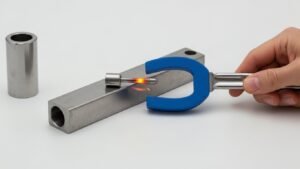
A key practical differentiator is magnetism. Unlike fully austenitic grades such as 304 or 316, duplex stainless steels are magnetic due to their high ferrite content. This provides a simple and reliable method for field identification and prevents material mix-ups during fabrication or installation.
Mechanical Strength and Industry Classifications
The most significant engineering advantage of duplex stainless steel is its mechanical performance. These alloys deliver a 0.2% proof strength (yield strength) of ≥450–550 MPa, which is approximately double that of standard austenitic grades like 304 and 316. This elevated strength allows designers to reduce wall thickness and overall weight in pressure-retaining components and structural members, leading to material cost savings without compromising safety or performance ratings.
The family is classified into several tiers based on alloy content and corrosion resistance: Lean Duplex (e.g., UNS S32101), Standard Duplex (UNS S32205/2205), and Super Duplex (e.g., UNS S32750/2507). Super duplex grades are specifically engineered for highly aggressive environments, achieving a Pitting Resistance Equivalent Number (PREN) greater than 40, making them the standard choice for seawater, offshore oil and gas, and complex chemical processing.
Operational limits for duplex steels are primarily defined by temperature. They maintain excellent toughness down to −50 °C but are generally limited to a maximum continuous service temperature of 275–300 °C. Service above this range risks “475 °C embrittlement” due to the precipitation of brittle phases from the high chromium content. These materials are strictly governed by international standards, including ASTM A240 for plate products, ASTM A790 for pipe, and ISO 15156/NACE MR0175 for safety in sour service environments.
Chemical Composition and Microstructure
Duplex stainless steels are defined by a dual-phase microstructure of roughly 50% austenite and 50% ferrite. This balance is achieved by high chromium (20–28%) and molybdenum (up to 5%) levels combined with controlled nitrogen and nickel additions, resulting in a material that is significantly stronger and more corrosion-resistant than 300-series stainless steels.
The Dual-Phase Matrix: Balancing Austenite and Ferrite
Solution-annealed duplex stainless steel is engineered to maintain a precise metallurgical phase balance, typically ranging between 40/60 and 60/40 austenite-to-ferrite ratios. This dual-phase matrix is the foundation of the material’s performance; ferrite stabilization is driven by high concentrations of Chromium (Cr), Molybdenum (Mo), and Silicon (Si). These elements promote the body-centered cubic structure that provides high yield strength and resistance to stress corrosion cracking.
To maintain the 50/50 ratio and prevent embrittlement, austenite stabilizers such as Nickel (Ni), Nitrogen (N), and Manganese (Mn) are precisely balanced against the ferritic formers. Nitrogen (0.14–0.50 wt%) is particularly vital in modern duplex alloys, serving a triple role: it stabilizes the austenite phase, increases the material’s yield strength, and significantly boosts the Pitting Resistance Equivalent (PREN). Additionally, maintaining low carbon levels (typically ≤0.03%) is critical during the melting process to avoid carbide precipitation at grain boundaries, ensuring robust intergranular corrosion resistance.
Alloy Grades and Pitting Resistance Equivalent (PREN)
The chemical makeup of duplex stainless steels determines their classification into standard, super, or hyper grades based on their corrosion metrics. Standard Duplex (2205 / UNS S32205) remains the industry workhorse, containing 22–23% Cr, 3.0–3.5% Mo, and 4.5–6.5% Ni to achieve a PREN of 35–36. For more aggressive chloride environments, Super Duplex (2507 / UNS S32750) utilizes an increased alloy window of 24–26% Cr and 3–5% Mo, pushing the PREN to 40–43.
At the peak of the alloy spectrum, Hyper Duplex (2707 / UNS S32707) pushes metallurgical limits with 26–29% Cr and 4–5% Mo, resulting in a PREN near 50 for extreme service conditions. However, the high content of Chromium, Molybdenum, and Tungsten increases the material’s sensitivity to intermetallic phase formation—such as sigma and chi phases—if the steel is exposed to temperatures between 600–1000 °C during welding or heat treatment. Rigorous compliance with international standards, including EN 10088-1:2014 and specific UNS designations, is required to ensure material traceability and the prevention of brittle phase precipitation.
Key Benefits of Duplex Stainless Steel [High Strength & Corrosion Resistance]
Duplex stainless steel provides nearly twice the yield strength of 300-series grades (≥450 MPa for 2205) due to its balanced 50/50 austenite-ferrite microstructure. This allows for thinner material sections and weight reduction while offering exceptional resistance to chloride stress corrosion cracking and pitting in harsh industrial environments.
Superior Yield Strength and Structural Weight Reduction
The balanced 50% austenite and 50% ferrite microstructure delivers a yield strength of ≥450 MPa (65 ksi) for 2205 duplex, which is nearly double the ~200 MPa typically found in 316L. High tensile strength, ranging from 620 to 800 MPa, enables engineers to design pressure vessels and pipelines with significantly thinner walls. This direct mechanical advantage leads to substantial weight reduction across the entire project without sacrificing structural integrity.
Beyond structural efficiency, significant cost savings are achieved by utilizing less material for the same load-bearing capacity. These performance metrics are fully supported by HnL STEEL’s comprehensive Material Test Certificates (MTC) to ensure complete traceability. Additionally, hardness levels reach approximately 270 HB for 2205 and 290 HB for Super Duplex 2507, providing the enhanced wear resistance necessary for abrasive industrial environments.
Exceptional Resistance to Chloride Stress Corrosion Cracking
The chemical composition of duplex stainless steel, featuring higher Chromium (Cr), Molybdenum (Mo), and Nitrogen (N), results in elevated Pitting Resistance Equivalent Numbers (PREN). This specific alloying offers superior protection against localized attacks, particularly pitting and crevice corrosion. Duplex grades excel in aggressive environments where standard 300-series steels often fail, providing critical resistance to Chloride Stress Corrosion Cracking (SCC) in marine and oil/gas applications.
Furthermore, these alloys maintain reliable mechanical performance in temperatures ranging from -50°C up to 250°C, making them an ideal choice for chemical processing and geothermal heat exchangers. The cost-effective alloying strategy uses lower Nickel content than high-performance austenitic grades, effectively reducing price volatility and lowering the total cost of ownership for large-scale infrastructure projects.
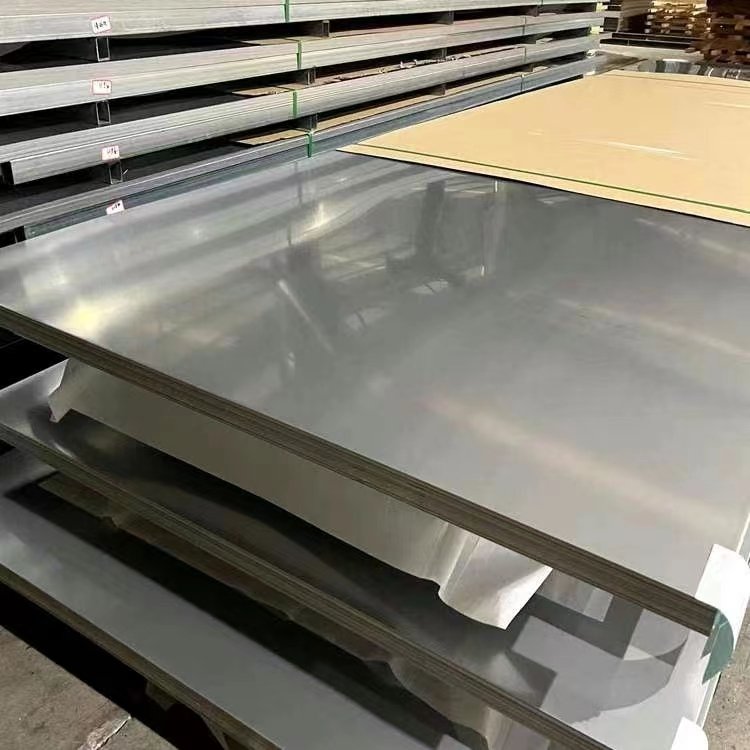
Durable, High-Performance Stainless Steel for Every Project
Duplex 2205 vs. Super Duplex 2507: Key Differences
The primary difference lies in alloying: Super Duplex 2507 contains higher Chromium (25%), Molybdenum (4%), and Nitrogen, resulting in a PREN >40 for seawater service. Duplex 2205 is the ‘workhorse’ grade with a PREN of 35-37, suitable for most industrial chloride environments but less resistant than 2507.
| Technical Property | Duplex 2205 (UNS S32205) | Super Duplex 2507 (UNS S32750) |
|---|---|---|
| Chromium (Cr) Content | 21–23% | 24–26% |
| Molybdenum (Mo) Content | 2.5–3.5% | 3.0–5.0% |
| Nitrogen (N) Content | 0.14–0.20% | 0.24–0.32% |
| PREN (Pitting Resistance) | 35–37 | ≥ 40 (Typical 40–45) |
| Yield Strength (0.2% Offset) | ≥ 450 MPa | ≥ 550 MPa |
| Tensile Strength (Rm) | ≥ 620 MPa | ≥ 800 MPa |
Chemical Composition and Pitting Resistance (PREN)
The metallurgical distinction between these two grades is defined by the concentration of key alloying elements. While 2205 (UNS S32205) features 21–23% Cr and 2.5–3.5% Mo, Super Duplex 2507 (UNS S32750) increases these levels to 24–26% Cr and 3–5% Mo. Furthermore, nitrogen content is significantly higher in 2507 (0.24–0.32%) compared to 2205 (0.14–0.20%), which is critical for stabilizing the austenite phase and boosting pitting resistance in harsh environments.
This chemical variance is best summarized by the Pitting Resistance Equivalent Number (PREN). Duplex 2205 provides a PREN range of 35–37, making it highly effective against chloride stress corrosion cracking (SCC) in industrial process water. However, for natural seawater service containing approximately 19,000 ppm Cl⁻, Super Duplex 2507 is required, as it must meet a minimum PREN of 40 to prevent localized corrosion and crevice attack.
Mechanical Properties and Industrial Application Ranges
Super Duplex 2507 offers a distinct mechanical advantage with a yield strength of ≥550 MPa, compared to the ≥450 MPa minimum for Duplex 2205. This increased strength allows engineers to design pressure vessels and piping with thinner wall sections, leading to significant weight reduction and lower material costs in large-scale installations. Tensile strength follows a similar trend, with 2507 reaching ≥800 MPa, providing superior structural integrity under extreme pressure.
Both grades are governed by ASTM A240/A240M standards for plate, sheet, and strip applications, yet their application focuses differ based on environmental severity. Duplex 2205 is considered the “workhorse” grade for chemical processing, oil refineries, and the freshwater side of desalination plants. In contrast, Super Duplex 2507 is reserved for the most demanding environments, including offshore oil and gas platforms, subsea manifolds, and high-pressure reverse osmosis (RO) systems where the risk of chloride-induced failure is highest.
Reducing Wall Thickness and Material Costs with Duplex
Duplex stainless steels like 2205 and 32760 offer yield strengths between 450–750 MPa—nearly double that of standard 316L austenitic steel. This high strength-to-weight ratio enables a 30–50% reduction in wall thickness for pressure vessels and storage tanks, significantly lowering material volume and logistical costs while maintaining structural integrity.
| Material Grade | Yield Strength (MPa) | Estimated Thickness Reduction |
|---|---|---|
| 316L Austenitic | ~210 – 250 | Baseline (0%) |
| 2205 Duplex | 450 – 550 | 30% – 38% |
| 32760 Super Duplex | 550 – 750 | 40% – 50% |
Mechanical Superiority: High Yield Strength and Weight Reduction
The mechanical advantage of duplex stainless steel originates from its dual-phase microstructure, typically consisting of a 40–60% balance of austenite and ferrite. This specific orientation acts as a natural barrier to dislocation movement and crack propagation. Super duplex grades like 32760 feature yield strengths reaching 550–750 MPa, which is approximately double the capacity of standard 316L austenitic alloys. By leveraging a high proof stress—often cited at 450 MPa for grade 2205—engineers can drastically reduce the structural mass of storage tanks and pressure vessels without compromising safety factors.
Despite the significant increase in strength, duplex alloys maintain excellent ductility. In solution-annealed conditions, these materials demonstrate elongation levels between 15–25% and a reduction of area exceeding 50%. This combination allows for thinner wall designs that remain resilient under pressure, facilitating a 30–50% reduction in total weight compared to traditional stainless steel alternatives.
Technical Specifications and Economic Impact
The economic benefits of duplex go beyond initial material volume. In industrial applications, such as the construction of 2205 digesters, project data has demonstrated a total wall thickness reduction of 38%. Modern design standards for storage tanks now permit a minimum top thickness of just 6 mm when utilizing high-strength duplex grades. This reduction in material volume directly correlates to lower shipping costs, easier handling, and a significant decrease in the amount of welding filler metal required for assembly.
However, utilizing these thinner sections requires strict adherence to technical constraints. Welding heat input must be precisely controlled between 0.5–2.5 kJ/mm to preserve the phase balance and prevent the loss of corrosion resistance or mechanical toughness. Furthermore, operational temperatures must be maintained below 300°C to avoid 475°C embrittlement in the ferrite phase. Fabrication processes for lean duplex like UR™ 2202 also require consideration for material stiffness, typically necessitating a minimum bend diameter of 3–4 times the thickness during forming operations.
Common Applications for 2205 and 2507
Duplex 2205 is the industry workhorse for chemical processing, pulp and paper, and oil refining where moderate chloride resistance is needed. Super duplex 2507 is reserved for extreme environments including offshore oil and gas, desalination seawater intakes, and high-pressure RO systems requiring a PREN > 40.
Industrial Processing and Chemical Applications for Duplex 2205
Standard duplex 2205 (UNS S32205 / S31803) serves as the primary “workhorse” grade across a broad spectrum of industrial processing environments. It is most commonly deployed in pulp and paper digesters and bleach plants, where its Pitting Resistance Equivalent Number (PREN) of 35–37 provides sufficient protection against localized corrosion from bleaching chemicals. In the petrochemical and refining sectors, 2205 is utilized for heat exchangers and storage tanks, leveraging a yield strength of ≥ 450 MPa—more than double that of conventional 316L stainless steel. This mechanical advantage allows engineers to design ASME-certified pressure vessels with significantly thinner shell walls, leading to reduced material weight and lower welding volumes.
Beyond heavy chemical processing, 2205 is an ideal candidate for desalination infrastructure, specifically in the feed and brine zones on the freshwater side where chloride levels are elevated but do not reach the extremes of open seawater. Its combination of structural load capacity and moderate chloride resistance makes it the preferred general-purpose duplex for refinery equipment and piping systems requiring long-term durability without the prohibitive cost of high-nickel alloys or super-austenitics like 904L.
Offshore and Marine Engineering Applications for Super Duplex 2507
Super duplex 2507 (UNS S32750) is specifically engineered for severe chloride exposure and high-pressure service conditions that exceed the performance envelope of standard duplex grades. It is a critical material for offshore oil and gas operations, including topside equipment, subsea manifolds, risers, and high-pressure injection systems. With a PREN exceeding 40 and documented resistance to chloride stress corrosion cracking in hot seawater, 2507 is the industry standard for seawater intake systems and high-pressure Reverse Osmosis (RO) piping trains in large-scale desalination plants.
In marine engineering and cooling systems, 2507 is extensively used in seawater heat exchangers and cooling water circuits where exposure to natural seawater or concentrated brine is constant. The alloy’s superior yield strength of ≥ 550 MPa enables significant wall-thickness reductions in high-pressure piping compared to 317L or 904L alloys. This structural efficiency is vital for weight-sensitive offshore platforms, while its resistance to extreme pitting ensures the reliability of failure-intolerant systems such as subsea manifolds and produced-water handling equipment.
Fabrication and Welding Considerations
Fabricating duplex stainless steel requires precise control of heat input (0.5–2.5 kJ/mm) and interpass temperatures (max 150°C) to maintain a 40–65% ferrite balance. Utilizing GTAW with nitrogen-rich shielding gas and adhering to ASTM A923 standards prevents the formation of brittle intermetallic phases like sigma, ensuring weld durability.
Thermal Management and Microstructural Control
To maintain the critical austenite-ferrite phase balance, heat input must be strictly regulated during the welding of duplex stainless steels. For standard duplex grades, fabricators must keep heat input within the 0.5–2.5 kJ/mm range, while super-duplex grades require a tighter window of 0.5–2.0 kJ/mm to prevent detrimental grain coarsening. Interpass temperatures must be carefully monitored and limited to a maximum of 150°C (300°F) for lean and standard duplex, or 100°C (210°F) for super-duplex grades, to ensure the stability of the microstructure.
Rapid cooling is essential to avoid the precipitation of brittle intermetallic phases, such as sigma, which typically occur between 300°C and 1000°C. Cooling rates (Vr700°C) should be maintained between 15°C/s and 50°C/s to preserve the integrity of the material. By adhering to these thermal parameters, the weld metal can achieve a target ferrite content of 40–65%, providing the optimal balance between mechanical strength and resistance to stress corrosion cracking.
Welding Processes, Shielding, and Quality Standards
Gas Tungsten Arc Welding (GTAW) is the preferred method for root passes and thin-walled sections (under 15 mm), ideally utilizing a Ø 2.4 mm filler wire. Maintaining welding speeds below 45 cm/min is vital for minimizing porosity and ensuring X-ray compactness under ASME Section VIII standards. The choice of shielding gas is equally critical; Argon enriched with 2% Nitrogen is recommended to stabilize the austenite phase, whereas Hydrogen additions must be strictly avoided to prevent the risk of cold cracking.
Industrial compliance and weld quality are verified through rigorous testing standards that go beyond basic mechanical qualifications. Implementation of ASTM A923 for phase and impact testing, alongside ASTM G48 for pitting corrosion assessment, ensures the weld will perform in its intended service environment. Furthermore, during the forming process, minimum bending diameters must be maintained at 3x the thickness for base metals and 4x for welded assemblies to mitigate the risk of surface cracking.
Choosing the Right Grade for Your Project
Selecting the correct duplex grade requires balancing the environmental corrosivity, measured by the Pitting Resistance Equivalent Number (PREN), against mechanical needs. Lean duplex (PREN 22-28) works for moderate settings, while standard 2205 and super duplex 2507 provide high yield strengths (450-550 MPa) and superior resistance for aggressive chloride or high-pressure applications.
Categorizing Grades by Pitting Resistance Equivalent Number (PREN)
The categorization of duplex stainless steel is primarily determined by its Pitting Resistance Equivalent Number (PREN), a calculated value derived from chromium, molybdenum, and nitrogen content. Lean duplex grades, such as LDX 2101 (UNS S32101), 2304 (UNS S32304), and 2003 (UNS S32003), offer a PREN range of 22–28. These grades serve as highly cost-effective alternatives to austenitic 316L in moderate environments, providing roughly double the yield strength of traditional austenitic steels while maintaining sufficient corrosion resistance for structural applications.
For more demanding industrial settings, standard duplex grade 2205 (UNS S32205/S31803) acts as the industry workhorse with a PREN of 28–38, offering superior resistance to stress corrosion cracking. In extreme environments involving aggressive chlorides or high acidity, Super Duplex grades like 2507 (UNS S32750) and F55 (UNS S32760) provide a PREN of 38–45. Hyper Duplex grades, such as UNS S32707, reach PREN values exceeding 45, ensuring integrity in the most severe chemical processing conditions where high chromium (up to 28%) and molybdenum are essential.
Evaluating Mechanical Strength and Thermal Limits
A defining characteristic of duplex stainless steel is its high mechanical performance. These alloys typically exhibit a 0.2% proof stress between 400 and 550 MPa, significantly outperforming the 200 MPa yield strength of austenitic 316L. For example, standard 2205 offers a yield strength ≥450 MPa and tensile strength of 620–800 MPa. This high strength allows engineers to specify thinner wall sections for pressure vessels and storage tanks. This weight reduction capability translates directly into lower material costs and reduced structural weight without compromising the load-bearing capacity or impact resistance of the installation.
Application of these grades must account for thermal limitations to prevent phase changes that lead to brittleness. Standard duplex grades like 2205 are generally restricted to a maximum continuous operating temperature of 300°C to avoid 475°C embrittlement, which can severely reduce toughness. To guarantee the reliability of these materials, HnL STEEL ensures all products comply with ISO 9001:2015 standards, providing comprehensive Material Test Certificates (MTC) that verify critical metrics such as Brinell hardness (typically 270–310 HB) and specific tensile properties required for high-pressure service.
Final Thoughts
Duplex stainless steels, particularly grades 2205 and 2507, represent a pivotal metallurgical advancement for modern industrial engineering. By successfully balancing a dual-phase microstructure of austenite and ferrite, these alloys deliver double the yield strength of standard 316L while providing superior resistance to chloride stress corrosion cracking and pitting. Whether utilizing the versatile 2205 for chemical processing or the high-PREN 2507 for aggressive seawater environments, duplex alloys bridge the gap between structural efficiency and long-term durability.
Ultimately, the choice to transition to duplex stainless steel is an investment in both performance and cost-efficiency. The material’s high strength-to-weight ratio allows for up to a 50% reduction in wall thickness, directly lowering logistical costs and material volume for pressure vessels and offshore infrastructure. By adhering to strict fabrication standards and precise thermal management during welding, engineers can leverage these high-performance materials to ensure the safety and longevity of critical systems in the world’s most demanding service conditions.
Frequently Asked Questions
What is duplex stainless steel?
Duplex stainless steel is a corrosion-resistant alloy featuring a dual-phase microstructure of approximately equal parts austenite and ferrite. It combines the high strength of ferritic steels with the toughness of austenitic grades, offering a minimum yield strength of ≥450 MPa—more than double that of typical austenitic grades like 316L.
Is 2205 duplex stainless steel better than 316L?
Yes, 2205 is superior to 316L in strength and corrosion resistance. It offers approximately double the yield strength and enhanced resistance to pitting and stress corrosion cracking. In pressure vessel design, using 2205 can enable 30-50% thinner walls while maintaining structural integrity.
Can you weld duplex stainless steel?
Yes, duplex steel can be welded using standard processes like GTAW, SMAW, and GMAW. However, it requires strict parameter control, including heat inputs between 0.5-2.5 kJ/mm and interpass temperatures limited to 150°C (300°F) to maintain the critical phase balance and material properties.
Why is it called ‘duplex’?
The name ‘duplex’ refers to the material’s dual-phase microstructure. It consists of roughly 50% austenite and 50% ferrite by volume, allowing the steel to benefit from the properties of both austenitic and ferritic stainless steel families.
Is duplex stainless steel magnetic?
Yes, duplex stainless steel is magnetic due to the ferrite phase in its microstructure. It typically exhibits a magnetic permeability of approximately 50, which distinguishes it from non-magnetic austenitic grades like 304 or 316.
What are the disadvantages of duplex stainless steel?
Key disadvantages include reduced low-temperature toughness compared to austenitic steels and a risk of ‘sigma phase’ formation when exposed to temperatures in the 700-955°C range. Additionally, its high strength makes it more difficult to machine and form than standard grades.